

Harold & Kumar Alle Jahre Wieder
| Harold Godwinson | |
|---|---|
 Harold Godwinson, from the Bayeux Tapestry | |
| Male monarch of the English | |
| Reign | 5 January – 14 October 1066 |
| Coronation | six January 1066 |
| Predecessor | Edward the Confessor |
| Successor |
|
| Built-in | c. 1022 Wessex, England |
| Died | 14 Oct 1066 (aged nigh 44) near Senlac Hill, Sussex, England |
| Burial | Waltham Abbey, Essex, or Bosham, Sussex (disputed) |
| Spouse |
|
| Issue |
|
| Firm | Godwin |
| Father | Godwin, Earl of Wessex |
| Mother | Gytha Thorkelsdóttir |
Harold Godwinson (c. 1022 – fourteen October 1066), also called Harold II, was the terminal crowned Anglo-Saxon English king. Harold reigned from 6 January 1066[ane] until his death at the Battle of Hastings, fighting the Norman invaders led by William the Conqueror during the Norman conquest of England. His death marked the end of Anglo-Saxon rule over England.
Harold Godwinson was a member of a prominent Anglo-Saxon family with ties to Cnut the Neat. He became a powerful earl afterward the death of his father, Godwin, Earl of Wessex. After his blood brother-in-law, Rex Edward the Confessor, died without an heir on 5 January 1066, the Witenagemot convened and chose Harold to succeed him; he was probably the first English monarch to be crowned in Westminster Abbey. In late September, he successfully repelled an invasion past rival claimant Harald Hardrada of Norway in York before marching his army dorsum due south to run into William the Conqueror at Hastings two weeks later.
Family background [edit]
Harold was a son of Godwin (c. 1001–1053), the powerful earl of Wessex, and of Gytha Thorkelsdóttir, whose brother Ulf the Earl was married to Estrid Svendsdatter (c. 1015/1016), the daughter of King Sweyn Forkbeard[ii] (died 1014) and sister of King Cnut the Keen of England and Denmark. Ulf and Estrid's son would become King Sweyn Two of Denmark[3] in 1047. Godwin was the son of Wulfnoth, probably a thegn and a native of Sussex. Godwin began his political career by supporting King Edmund Ironside (reigned Apr to Nov 1016), only switched to supporting Male monarch Cnut by 1018, when Cnut named him Earl of Wessex.[4] Godwin remained an earl throughout the remainder of Cnut's reign, one of only two earls to survive to the end of that reign.[five] On Cnut's death in 1035, Godwin originally supported Harthacnut instead of Cnut's initial successor Harold Harefoot, only managed to switch sides in 1037—although not without condign involved in the 1036 murder of Alfred Aetheling, half-blood brother of Harthacnut and younger brother of the after King Edward the Confessor.[6] When Harold Harefoot died in 1040, Harthacnut ascended the English throne and Godwin'southward power was imperiled by his earlier involvement in Alfred'southward murder, but an adjuration and big gift secured the new male monarch'southward favour for Godwin.[7] Harthacnut'southward death in 1042 probably involved Godwin in a role equally kingmaker, helping to secure the English throne for Edward the Confessor. In 1045 Godwin reached the top of his ability when the new king married Godwin's girl Edith.[8] Godwin and Gytha had several children—six sons: Sweyn, Harold, Tostig, Gyrth, Leofwine and Wulfnoth (in that order); and three daughters: Edith of Wessex (originally named Gytha merely renamed Ealdgyth (or Edith) when she married Rex Edward the Confessor), Gunhild and Ælfgifu. The birthdates of the children are unknown.[9] Harold was aged almost 25 in 1045, which makes his birth year around 1020.[10]
Powerful nobleman [edit]
Edith married Edward on 23 January 1045 and, effectually that time, Harold became Earl of Due east Anglia. Harold is called "earl" when he appears as a witness in a will that may engagement to 1044; but, by 1045, Harold regularly appears as an earl in documents. I reason for his appointment to East Anglia may accept been a need to defend against the threat from King Magnus the Good of Norway. It is possible that Harold led some of the ships from his earldom that were sent to Sandwich in 1045 against Magnus.[eleven] Sweyn, Harold's elder brother, had been named an earl in 1043.[12] Information technology was also around the time that Harold was named an earl that he began a relationship with Edith the Off-white, who appears to have been the heiress to lands in Cambridgeshire, Suffolk and Essex, lands in Harold'due south new earldom.[13] The human relationship was a form of wedlock that was not blessed or sanctioned by the Church, known as More than danico, or "in the Danish manner", and was accustomed by almost laypeople in England at the fourth dimension. Whatsoever children of such a union were considered legitimate. Harold probably entered the relationship in part to secure support in his new earldom.[14]
Harold's elder brother Sweyn was exiled in 1047 afterward abducting the abbess of Leominster. Sweyn's lands were divided between Harold and a cousin, Beorn.[15] In 1049, Harold was in command of a send or ships that were sent with a fleet to assist Henry Iii, Holy Roman Emperor against Baldwin V, Count of Flanders, who was in defection against Henry. During this campaign, Sweyn returned to England and attempted to secure a pardon from the male monarch, only Harold and Beorn refused to return any of their lands, and Sweyn, subsequently leaving the royal court, took Beorn earnest and later killed him.[16]
In 1051 Edward appointed an enemy of the Godwins as Archbishop of Canterbury and soon afterwards collection them into exile, merely they raised an ground forces which forced the rex to restore them to their positions a year later. Earl Godwin died in 1053, and Harold succeeded him equally Earl of Wessex, which fabricated him the virtually powerful lay figure in England after the male monarch.[17]
In 1055 Harold drove dorsum the Welsh, who had burned Hereford.[18] Harold also became Earl of Hereford in 1058, and replaced his tardily father as the focus of opposition to growing Norman influence in England under the restored monarchy (1042–66) of Edward the Confessor, who had spent more than 25 years in exile in Normandy. He led a series of successful campaigns (1062–63) against Gruffydd ap Llywelyn of Gwynedd, king of Wales. This disharmonize concluded with Gruffydd'due south defeat and death in 1063.[19]
Harold in northern France [edit]

HAROLD SACRAMENTUM FECIT VVILLELMO DUCI ("Harold made an oath to Duke William"). (Bayeux Tapestry) This scene is stated in the previous scene on the Tapestry to accept taken place at Bagia (Bayeux, probably in Bayeux Cathedral). Information technology shows Harold touching two altars with the enthroned Duke looking on, and is central to the Norman Invasion of England.
In 1064, Harold was evidently shipwrecked at Ponthieu. There is much speculation near this voyage. The earliest mail-conquest Norman chroniclers report that King Edward had previously sent Robert of Jumièges, the archbishop of Canterbury, to appoint every bit his heir Edward'due south maternal kinsman, Duke William Two of Normandy, and that at this later date Harold was sent to swear fealty.[20] Scholars disagree as to the reliability of this story. William, at to the lowest degree, seems to have believed he had been offered the succession, but there must take been some confusion either on William'southward part or perhaps by both men, since the English succession was neither inherited nor determined by the reigning monarch. Instead the Witenagemot, the assembly of the kingdom'due south leading notables, would convene after a king's death to select a successor. Other acts of Edward are inconsistent with his having fabricated such a promise, such as his efforts to return his nephew Edward the Exile, son of King Edmund Ironside, from Hungary in 1057.[a] Later Norman chroniclers suggest alternative explanations for Harold's journey: that he was seeking the release of members of his family unit who had been held earnest since Godwin's exile in 1051, or even that he had only been travelling along the English language coast on a hunting and line-fishing expedition and had been driven across the Channel by an unexpected storm. There is general agreement that he left from Bosham, and was blown off course, landing at Ponthieu. He was captured by Count Guy I of Ponthieu, and was then taken as a hostage to the count'southward castle at Beaurain,[b] 24.v km (xv.2 mi) upwards the River Canche from its mouth at what is now Le Touquet. Duke William arrived soon subsequently and ordered Guy to turn Harold over to him.[21] Harold and then apparently accompanied William to battle against William's enemy Duke Conan Two, Duke of Brittany. While crossing into Brittany past the fortified abbey of Mont Saint-Michel, Harold is recorded as rescuing 2 of William's soldiers from quicksand. They pursued Conan from Dol-de-Bretagne to Rennes, and finally to Dinan, where he surrendered the fortress'south keys at the betoken of a lance. William presented Harold with weapons and arms, knighting him. The Bayeux Tapestry, and other Norman sources, then tape that Harold swore an oath on sacred relics to William to support his merits to the English language throne. Afterward Edward's death, the Normans were quick to point out that in accepting the crown of England, Harold had broken this declared oath.[22]
The chronicler Orderic Vitalis wrote of Harold that he "was distinguished by his keen size and strength of body, his polished manners, his firmness of mind and control of words, past a gear up wit and a variety of excellent qualities. Merely what availed then many valuable gifts, when good faith, the foundation of all virtues, was wanting?"[23]
Due to a doubling of taxation past Tostig in 1065 that threatened to plunge England into ceremonious war, Harold supported Northumbrian rebels against his brother Tostig, and replaced him with Morcar. This led to Harold's spousal relationship alliance with the northern earls but fatally split his ain family, driving Tostig into alliance with King Harald Hardrada ("Hard Ruler") of Norway.[24]
Reign [edit]

HIC RESIDET HAROLD Rex ANGLORUM. STIGANT ARCHIEP[ISCOPU]South. "Here sits Harold King of the English. Archbishop Stigand". Scene immediately after crowning of Harold past (co-ordinate to the Norman tradition) Archbishop of Canterbury Stigand (d. 1072). Particular from the Bayeux Tapestry.
At the end of 1065, King Edward the Confessor fell into a coma without clarifying his preference for the succession. He died on 5 Jan 1066, according to the Vita Ædwardi Regis, only non before briefly regaining consciousness and commending his widow and the kingdom to Harold'southward "protection". The intent of this accuse remains ambiguous, as is the Bayeux Tapestry, which just depicts Edward pointing at a man idea to represent Harold.[c] When the Witan convened the next day they selected Harold to succeed,[d] and his coronation followed on 6 January, nearly likely held in Westminster Abbey, though no prove from the fourth dimension survives to confirm this.[26] Although after Norman sources betoken to the suddenness of this coronation, the reason may accept been that all the nobles of the land were present at Westminster for the feast of Epiphany, and not because of any usurpation of the throne on Harold's part.
In early January 1066, hearing of Harold'south coronation, Duke William II of Normandy began plans to invade England, building 700 warships and transports at Dives-sur-Mer on the Normandy declension. Initially, William could not go support for the invasion simply, claiming that Harold had sworn on sacred relics to support his claim to the throne after having been shipwrecked at Ponthieu, William received the Church's blessing and nobles flocked to his cause. In anticipation of the invasion, Harold assembled his troops on the Isle of Wight, simply the invasion fleet remained in port for nigh seven months, mayhap due to unfavourable winds. On 8 September, with provisions running out, Harold disbanded his ground forces and returned to London. On the aforementioned day Harald Hardrada of Norway, who also claimed the English language crown,[east] joined Tostig and invaded, landing his armada at the mouth of the Tyne.
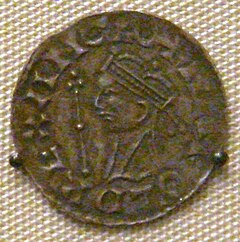
Money of King Harold Godwinson
The invading forces of Hardrada and Tostig defeated the English earls Edwin of Mercia and Morcar of Northumbria at the Battle of Fulford most York on 20 September 1066. Harold led his regular army north on a forced march from London, reached Yorkshire in 4 days, and defenseless Hardrada by surprise. On 25 September, in the Battle of Stamford Bridge, Harold defeated Hardrada and Tostig, who were both killed.
According to Snorri Sturluson, in a story described by Edward Freeman equally "manifestly mythical",[27] earlier the boxing a unmarried man rode upwards alone to Harald Hardrada and Tostig. He gave no proper noun, but spoke to Tostig, offering the return of his earldom if he would plow against Hardrada. Tostig asked what his blood brother Harold would be willing to give Hardrada for his trouble. The rider replied "7 feet of English ground, as he is taller than other men." So he rode back to the Saxon host. Hardrada was impressed by the rider's boldness, and asked Tostig who he was. Tostig replied that the rider was Harold Godwinson himself.[28]
Battle of Hastings [edit]

Gyrth and his brother'south death at the Boxing of Hastings, scene 52 of the Bayeux Tapestry.
HIC CECIDERUNT LEVVINE ET GYRÐ FRATRES HAROLDI REGIS
(Here have fallen dead Leofwine and Gyrth, brothers of King Harold)
On 12 September 1066 William's fleet sailed from Normandy. Several ships sank in storms, which forced the fleet to take shelter at Saint-Valery-sur-Somme and to wait for the air current to alter. On 27 September the Norman fleet set up sail for England, arriving the post-obit 24-hour interval at Pevensey on the coast of East Sussex. Harold's army marched 241 miles (386 kilometres) to intercept William, who had landed perhaps seven,000 men in Sussex, southern England. Harold established his army in hastily built digging almost Hastings. The two armies clashed at the Battle of Hastings, at Senlac Hill (virtually the nowadays town of Battle) shut past Hastings on 14 October, where later nine hours of difficult fighting, Harold was killed and his forces defeated. His brothers Gyrth and Leofwine were besides killed in the battle, according to the Anglo-Saxon Chronicle.[29] [ non-primary source needed ]
Decease [edit]
The notion that Harold died by an pointer to the heart is a popular belief today, but this historical legend is bailiwick to much scholarly debate. A Norman account of the battle, Carmen de Hastingae Proelio ("Song of the Battle of Hastings"), said to have been written shortly afterward the battle by Guy, Bishop of Amiens, says that Harold was killed by four knights, probably including Knuckles William, and his body dismembered. Twelfth-century Anglo-Norman histories, such as William of Malmesbury'southward Gesta Regum Anglorum and Henry of Huntingdon's Historia Anglorum recount that Harold died past an arrow wound to his caput. An before source, Amatus of Montecassino's 50'Ystoire de li Normant ("History of the Normans"), written merely xx years after the battle of Hastings, contains a written report of Harold existence shot in the eye with an pointer, but this may be an early fourteenth-century improver.[30] Subsequently accounts reverberate 1 or both of these two versions.
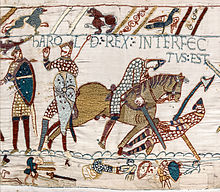
Harold'due south death depicted in the Bayeux Tapestry, reflecting the tradition that Harold was killed by an arrow in the eye. The note above states [Hic] Harold Rex interfectus est, "[Hither] Rex Harold is killed".
A effigy in the panel of the Bayeux Tapestry with the inscription "Hic Harold King Interfectus Est" ("Here King Harold is killed") is depicted gripping an pointer that has struck his centre, just some historians have questioned whether this human is intended to be Harold or if Harold is intended as the next figure lying to the correct virtually supine, existence mutilated below a horse's hooves. Etchings made of the Tapestry in the 1730s show the continuing figure with differing objects. Benoît's 1729 sketch shows merely a dotted line indicating sew marks without any indication of fletching, whereas all other arrows in the Tapestry are fletched. Bernard de Montfaucon's 1730 engraving has a solid line resembling a spear being held overhand matching the style of the figure to the left. Stothard's 1819 water-colour drawing has, for the starting time time, a fletched arrow in the effigy'southward eye. Although not apparent in the earlier depictions, the Tapestry today has stitch marks indicating the fallen figure once had an pointer in its centre. It has been proposed that the second figure once had an arrow added by over-enthusiastic nineteenth-century restorers that was later unstitched.[31] Many believe this, equally the name "Harold" is in a higher place the figure with an pointer in his center. This has been disputed past examining other examples from the Tapestry where the visual centre of a scene, non the location of the inscription, identifies named figures.[32] Further bear witness is that an arrow volley would be loosed before the Norman cavalry charge. A further suggestion is that both accounts are accurate, and that Harold suffered offset the centre wound, then the mutilation, and the Tapestry is depicting both in sequence.[33]
Burying and legacy [edit]
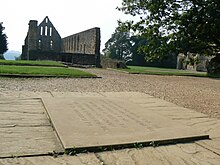
The spot where Harold reportedly died, which became the site of Battle Abbey in East Sussex.
The account of the gimmicky chronicler William of Poitiers states that the body of Harold was given to William Malet for burial:
The ii brothers of the King were found near him and Harold himself, stripped of all badges of accolade, could not be identified by his face merely but by certain marks on his body. His corpse was brought into the Duke's campsite, and William gave it for burial to William, surnamed Malet, and non to Harold'due south female parent, who offered for the body of her beloved son its weight in gilt. For the Duke idea information technology unseemly to receive money for such merchandise, and as he considered it wrong that Harold should exist buried equally his mother wished, since so many men lay unburied considering of his avarice. They said in jest that he who had guarded the coast with such insensate zeal should be buried by the seashore.
—William of Poitiers Gesta Guillelmi II Ducis Normannorum in English Historical Documents 1042–1189 p. 229

Bosham Church in Due west Sussex: the lower 3 storeys of the tower are Saxon, the elevation storey Norman
Another source states that Harold's widow, Edith Swannesha, was called to identify the body, which she did by some individual marker known only to her. Harold's potent association with Bosham, his birthplace, and the discovery in 1954 of an Anglo-Saxon coffin in the church at that place, has led some to suggest it every bit the identify of King Harold'southward burial. A asking to exhume a grave in Bosham Church building was refused by the Diocese of Chichester in December 2003, the Chancellor having ruled that the chances of establishing the identity of the trunk as Harold's were as well slim to justify agonizing a burial place.[f] A prior exhumation had revealed the remains of a human being, estimated at up to 60 years of age from photographs of the remains, lacking a caput, one leg and the lower part of his other leg, a description consistent with the fate of the rex as recorded in the Carmen. The poem also claims Harold was buried by the sea, which is consistent with William of Poitiers' account and with the identification of the grave at Bosham Church that is only yards from Chichester Harbour and in sight of the English Channel.[34]
At that place were legends of Harold's body being given a proper funeral years later in his church at Waltham Holy Cross in Essex, which he had refounded in 1060. Legends likewise grew upwardly that Harold had not died at Hastings but instead fled England or that he subsequently ended his life every bit a hermit at Chester or Canterbury.[35]
Harold'southward son Ulf, along with Morcar and two others, were released from prison house by King William as he lay dying in 1087. Ulf threw his lot in with Robert Curthose, who knighted him, and so disappeared from history. Ii of Harold's other sons, Godwine and Edmund, invaded England in 1068 and 1069 with the aid of Diarmait mac Máel na mBó (High King of Republic of ireland) but were defeated at the Boxing of Northam.[chiliad] In 1068, Diarmait presented another Irish king with Harold's battle standard.[36]
Marriages and children [edit]
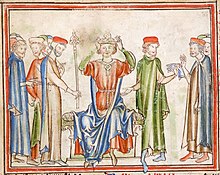
For some xx years Harold was married more danico (Latin: "in the Danish manner") to Edith the Fair and had at to the lowest degree six children with her. She was considered Harold's mistress past the clergy.[h]
According to Orderic Vitalis, Harold was at some time matrimonial to Adeliza, a girl of William the Conquistador; if so, the betrothal never led to spousal relationship.[37]
About January 1066, Harold married Edith (or Ealdgyth), daughter of Ælfgar, Earl of Mercia, and widow of the Welsh prince Gruffydd ap Llywelyn. Edith had one son, named Harold, probably born posthumously.[17] [38] [39] Some other of Harold'south sons, Ulf, may have been a twin of the younger Harold, though well-nigh historians consider him a son of Edyth Swannesha.[17] [twoscore] [38] [41] Both these sons survived into machismo and probably lived out their lives in exile.[ citation needed ]
Afterward her husband'southward expiry, Edith fled for refuge to her brothers, Edwin, Earl of Mercia and Morcar of Northumbria, but both men fabricated their peace with King William initially before rebelling and losing their lands and lives. Edith may have fled abroad (possibly with Harold'southward mother, Gytha, or with Harold'due south girl, Gytha). Harold'south sons, Godwin and Edmund, fled to Ireland and then invaded Devon, but were defeated by Brian of Brittany.[i] [ citation needed ]
Family tree [edit]
| Family unit of Harold Godwinson | |||||||||||||||||||||||||||||||||||||||||||||||||||||||||||||||||||||||||||||||||||||||||||||||||||||||||||||||||||||||||||||||||||||||||||||||||||||||||||||||||||||||||||||||||||||||||||||||||||||||||||||||||||||||||||||||||||||||||||||||||||||||||||||||||||||||||||||||||||||||||||||||||||||||||||||||||||||||||||||||||||||||||||||||||||||||||||||||||||||||||||||||||||||||||||||||||||||||||||||||||||||||||||||||||||||||||||||||||||||||||||||||||||||||||||||||||||||||||||||||||||||||||||||||||||||||||||||||||||||||||||||
|---|---|---|---|---|---|---|---|---|---|---|---|---|---|---|---|---|---|---|---|---|---|---|---|---|---|---|---|---|---|---|---|---|---|---|---|---|---|---|---|---|---|---|---|---|---|---|---|---|---|---|---|---|---|---|---|---|---|---|---|---|---|---|---|---|---|---|---|---|---|---|---|---|---|---|---|---|---|---|---|---|---|---|---|---|---|---|---|---|---|---|---|---|---|---|---|---|---|---|---|---|---|---|---|---|---|---|---|---|---|---|---|---|---|---|---|---|---|---|---|---|---|---|---|---|---|---|---|---|---|---|---|---|---|---|---|---|---|---|---|---|---|---|---|---|---|---|---|---|---|---|---|---|---|---|---|---|---|---|---|---|---|---|---|---|---|---|---|---|---|---|---|---|---|---|---|---|---|---|---|---|---|---|---|---|---|---|---|---|---|---|---|---|---|---|---|---|---|---|---|---|---|---|---|---|---|---|---|---|---|---|---|---|---|---|---|---|---|---|---|---|---|---|---|---|---|---|---|---|---|---|---|---|---|---|---|---|---|---|---|---|---|---|---|---|---|---|---|---|---|---|---|---|---|---|---|---|---|---|---|---|---|---|---|---|---|---|---|---|---|---|---|---|---|---|---|---|---|---|---|---|---|---|---|---|---|---|---|---|---|---|---|---|---|---|---|---|---|---|---|---|---|---|---|---|---|---|---|---|---|---|---|---|---|---|---|---|---|---|---|---|---|---|---|---|---|---|---|---|---|---|---|---|---|---|---|---|---|---|---|---|---|---|---|---|---|---|---|---|---|---|---|---|---|---|---|---|---|---|---|---|---|---|---|---|---|---|---|---|---|---|---|---|---|---|---|---|---|---|---|---|---|---|---|---|---|---|---|---|---|---|---|---|---|---|---|---|---|---|---|---|---|---|---|---|---|---|---|---|---|---|---|---|---|---|---|---|---|---|---|---|---|---|---|---|---|---|---|---|---|---|---|---|---|---|---|---|---|---|---|---|---|---|---|---|---|---|---|---|---|---|---|---|---|---|---|---|---|---|---|---|---|---|---|---|---|---|---|---|---|---|---|---|---|---|---|---|---|---|---|---|---|---|---|---|---|---|---|---|---|---|---|---|---|---|---|---|---|---|---|---|---|---|---|---|---|---|---|---|---|---|---|---|---|---|---|---|---|---|---|---|---|---|---|---|---|
| |||||||||||||||||||||||||||||||||||||||||||||||||||||||||||||||||||||||||||||||||||||||||||||||||||||||||||||||||||||||||||||||||||||||||||||||||||||||||||||||||||||||||||||||||||||||||||||||||||||||||||||||||||||||||||||||||||||||||||||||||||||||||||||||||||||||||||||||||||||||||||||||||||||||||||||||||||||||||||||||||||||||||||||||||||||||||||||||||||||||||||||||||||||||||||||||||||||||||||||||||||||||||||||||||||||||||||||||||||||||||||||||||||||||||||||||||||||||||||||||||||||||||||||||||||||||||||||||||||||||||||||
References [edit]
Notes [edit]
- ^ Edward may not take been blameless in this situation, as at least i other man, Sweyn 2 of Denmark, besides thought Edward had promised him the succession.[20]
- ^ Bayeux Tapestry, in which the place is called in Latin Belrem
- ^ Frank Barlow points out that the author of the Vita, who appears to accept looked favourably on Harold, was writing later the Conquest and may take been intentionally vague.[25]
- ^ This was in preference to Edward'south smashing-nephew, Edgar the Ætheling, who had yet to achieve maturity.
- ^ His merits came through a succession pact concluded between Harthacnut, male monarch of England and Denmark, and Magnus I of Kingdom of norway, whereby the kingdoms of the beginning to dice were to pass to the survivor. Magnus had thus gained a claim to Denmark on Harthacnut's death but had not pursued this other crown. Hardrada, uncle and heir of Magnus, now claimed England on this footing.
- ^ In re Holy Trinity, Bosham [2004] Fam 124 – decision of the Chichester Consistory Court regarding opening King Harold's supposed grave.
- ^ At midsummer in 1069, Brian of Brittany and Alan the Blackness led a force that defeated a raid by Godwine and Edmund, sons of Harold Godwinson, who had sailed from Ireland with a fleet of 64 ships to the mouth of the River Taw in Devon. They had escaped to Leinster afterwards the Battle of Hastings in 1066 where they were hosted by Diarmait. In 1068 and 1069 Diarmait lent them the armada of Dublin for their attempted invasions of England.
- ^ At this time there were a range of spousal relationships, from outright concubinage to fully recognised, church building-sanctioned marriages. There are no contemporary sources for Harold's marriages, but the writings of later Norman chroniclers, who had a more church building-centered view, and also had motivation to diminish the status of Harold's children. Consequently, the exact status of the relationship between King Harold Godwinson and Edyth Swannesha is unclear.[ citation needed ]
- ^ At midsummer in 1069, Brian and Alan the Black led a force that defeated a raid by Godwin and Edmund, sons of Harold Godwinson, who had sailed from Ireland with a fleet of 64 ships to the mouth of the River Taw in Devon. They had escaped to Leinster later on the Battle of Hastings in 1066 where they were hosted by Diarmait. In 1068 and 1069 Diarmait lent them the fleet of Dublin for their attempted invasions of England.
Citations [edit]
- ^ DeVries 1999.
- ^ Walker Harold p. 10
- ^ Barlow Feudal Kingdom p. 451
- ^ Walker Harold pp. vii–nine
- ^ Walker Harold p. 12
- ^ Walker Harold pp. 13–15
- ^ Walker Harold p. xvi
- ^ Walker Harold pp. 17–18
- ^ Mason Firm of Godwine p. 35
- ^ Rex Harold p. 31.
- ^ Walker Harold pp. 18–19
- ^ Barlow Edward the Confessor p. 74.
- ^ Walker Harold p. 20.
- ^ Walker Harold pp. 127–128.
- ^ Walker Harold p. 22
- ^ Walker Harold pp. 24–25.
- ^ a b c Fleming 2010.
- ^ Chisholm, Hugh, ed. (1911). . Encyclopædia Britannica. Vol. thirteen (11th ed.). Cambridge University Printing. p. 11.
- ^ "Harold Two". Encyclopædia Britannica . Retrieved 21 January 2020.
- ^ a b Howarth 1066 pp. 69–70
- ^ Howarth 1066 pp. 71–72
- ^ Freeman 1869, pp. 165–166.
- ^ Orderic Vitalis (1853). Historia Ecclesiastica. Translated past Forester, Thomas. Retrieved 4 January 2018.
- ^ DeVries 1999, p. 230.
- ^ Barlow Edward the Confessor p. 251
- ^ "Westminster Abbey Official site – Coronations"
- ^ Freeman 1869, p. 365.
- ^ Sturluson, King Harald's Saga p. 149.
- ^ "Anglo-Saxon Chronicle (D and E)". 1066. Archived from the original on 22 March 2017.
- ^ Foys, Pulling the Arrow Out, 161–63
- ^ Bernstein, Mystery of the Bayeux Tapestry, 148–152.
- ^ Foys, Pulling the Arrow Out, 171–75
- ^ Brooks and Walker, Authorisation and Interpretation, 81–92.
- ^ The Debate concerning the remains constitute in Bosham Church building Archived 3 February 2009 at the Wayback Auto Bosham Online Magazine 25 Nov 2003 Updated to include the Chancellor'south ruling of 10 Dec 2003
- ^ Walker Harold pp. 181–182
- ^ Bartlett & Jeffery 1997, p. 59.
- ^ Round 1885.
- ^ a b Fryde et al. 2003, p. 29.
- ^ Freeman 1871, p. 756.
- ^ Maund 2004.
- ^ Barlow 2013, p. 128.
Sources [edit]
- Barlow, Frank (1970). Edward the Confessor . Los Angeles, California: University of California Press. ISBN9780520016712.
- Barlow, Frank (1988). The Feudal Kingdom of England 1042–1216 (4th ed.). New York: Longman. ISBN0-582-49504-0.
- Barlow, Frank (2013). The Godwins: The Ascension and Fall of a Noble Dynasty. Abingdon: Routledge. ISBN9780582784406.
- Bartlett, Thomas; Jeffery, Keith (1997). A Military machine History of Ireland. Cambridge: University Press. ISBN978-0-521-62989-8.
- Bernstein, David (1986). The Mystery of the Bayeux Tapestry. Univ of Chicago Pr. ISBN0-226-04400-ix.
- Brooks, N. P.; Walker, H. Eastward. (1997). "The Authority and Estimation of the Bayeux Tapestry". In Gameson, Richard (ed.). The Study of the Bayeux Tapestry. Boydell and Brewer. pp. 63–92. ISBN0-85115-664-nine.
- DeVries, Kelly (1999). The Norwegian Invasion of England in 1066. Woodbridge: Boydell. ISBN9781843830276.
- Fleming, Robin (23 September 2010). "Harold Two [Harold Godwineson] (1022/3?–1066)". Oxford Dictionary of National Biography (online ed.). Oxford University Printing. doi:10.1093/ref:odnb/12360. (Subscription or UK public library membership required.)
- Foys, Martin (2010). "Pulling the Arrow Out: The Legend of Harold's Death and the Bayeux Tapestry". In Foys; Overbey, Karen Eileen; Terkla, Dan (eds.). Bayeux Tapestry: New Interpretations. Boydell and Brewer. pp. 158–75. ISBN978-1-84383-470-0.
- Freeman, Edward Augustus (1869). The History of the Norman Conquest of England: The Reign of Harold and the Interregnum. New York: Macmillan.
- Freeman, Edward A. (1871). The History of the Norman Conquest of England: Its Causes and Its Results. Oxford: Clarendon Press.
- Fryde, E. B.; Greenway, D. E.; Porter, S.; Roy, I., eds. (2003). Handbook of British Chronology (3rd, reprinted ed.). Cambridge: University Press. p. 29. ISBN0861931068.
- Howarth, David (1983). 1066: The Year of the Conquest. Penguin Books.
- Stonemason, Emma (2004). Firm of Godwine: The History of Dynasty. London: Hambledon & London. ISBN1-85285-389-1.
- Maund, K.50. (23 September 2004). "Ealdgyth [Aldgyth]". Oxford Dictionary of National Biography (online ed.). Oxford University Press. doi:10.1093/ref:odnb/307. (Subscription or UK public library membership required.)
- King, Peter (2005). Harold 2: The Doomed Saxon King. Stroud, UK: Tempus. ISBN978-0-7394-7185-2.
- Round, J. H. (1885). . In Stephen, Leslie (ed.). Dictionary of National Biography. Vol. i. London: Smith, Elderberry & Co.
- Sturluson, Snorri (1966). King Harald'due south Saga. Baltimore, Maryland: Penguin Books.
- Walker, Ian (2000). Harold the Last Anglo-Saxon King. Gloucestershire: Wrens Park. ISBN0-905778-46-4.
- William of Poitiers, Gesta Guillelmi 2 Ducis Normannorum, or "The Deeds of William II, Knuckles of the Normans". Quoted by David C. Douglas & George W. Greenaway (eds.), in: English Historical Documents 1042–1189, London, 1959.
Further reading [edit]
- van Kempen, Advertisement F. J. (Nov 2016). "'A mission he bore – to Duke William he came': Harold Godwineson's Commentum and his covert ambitions". Historical Research. 89 (246): 591–612. doi:10.1111/1468-2281.12147.
External links [edit]
- Harold 3 at Prosopography of Anglo-Saxon England
- BBC Historic Figures: Harold Two (Godwineson) (c. 1020–1066)
- Portraits of King Harold Ii (Harold Godwineson) at the National Portrait Gallery, London

Source: https://en.wikipedia.org/wiki/Harold_Godwinson
Posted by: mcbridefarretionly.blogspot.com
0 Response to "Harold & Kumar Alle Jahre Wieder"
Post a Comment