

How To Uninstall Iis In Windows Server 2012 R2
This browser is no longer supported.
Upgrade to Microsoft Edge to accept advantage of the latest features, security updates, and technical support.
Installing IIS 8.5 on Windows Server 2012 R2
This document describes how to install Cyberspace Information Services (IIS) 8.5 on Windows Server® 2012 R2. IIS is the Web server role in Windows Server 2012 R2. The Windows Server 2012 R2 operating system has all the IIS features needed to support the hosting of Spider web content in production environments. Windows viii also includes IIS features, but feature availability depends on the operating system version.
Notation
Yous can utilize the procedures in this document to install IIS viii.0 or IIS 8.5.
The Web server has a modular design that enables you to customize a server past adding or removing modules to come across your specific needs. The Install IIS 8.v on Windows Server 2012 R2 department describes how to install modules, and the Modules in IIS 8.5 section below describes the functionality that each module provides and which modules are installed by default.
New in IIS eight.five
IIS eight.5 includes several new features not found in IIS 8.0 or lower:
- Enhanced logging. An administrator can enable the logging of additional custom fields from request or response headers, or from server variables.
- Logging to event tracing for Windows. An administrator tin enable the sending of logging data to Event Tracing for Windows (ETW).
- Dynamic Website activation. If there are a big number of configured sites (100 or greater, by default), the service will not activate any of the sites when the service is started.
- Idle Worker Process Page-Out. An ambassador can enable an idle worker process to exist suspended rather than terminated.
For more information on these features, see What's New in IIS 8.5.
For information on new features in IIS 8.0, see What's New in IIS viii.0.
Before Yous Brainstorm
Ensure that you take administrative user rights on the computer on which you program to install IIS 8.5. Notation that by default, you do not have authoritative user rights if you are logged on every bit a user other than equally the built-in ambassador, even if y'all were added to the local Administrators group on the computer.
Log on either to the built-in administrator business relationship, or explicitly invoke applications equally the built-in administrator by using the runas command-line tool.
Note
You tin run runas /user:administrator cmd.exe then that every awarding you run from that command line volition be elevated, eliminating the demand to use the runas syntax from that command line.
If y'all are logged on to an business relationship other than the born local administrator business relationship, you may see the post-obit security alert dialog box.

Install IIS eight.5 on Windows Server 2012 R2
IIS is one of the server roles on Windows Server 2012 R2, named Web Server (IIS). You can utilize the following to install IIS:
- The Server Manager user interface in Windows Server 2012 R2
- A command-line installation using DISM (Deployment Image Servicing and Management)
- A command-line installation using PowerShell cmdlets
Note
IIS tin also be installed on Windows 8 through the Turn Windows features on or off dialog box from the Programs and Features settings of the Control Panel.
Install IIS 8.5 using the Server Director
Server Manager provides a single dashboard to install or uninstall server roles, role services, and features. Server Manager also gives an overview of all currently installed roles and features.
When you lot install IIS 8.5 using the Windows Server 2012 R2 Server Director, the steps y'all perform are different when you install IIS for the kickoff fourth dimension, as opposed to when you add roles, services, or features to an existing IIS installation. The ii procedures are provided beneath. Different procedures are also used to add together and remove roles, role services, and features. You cannot add and remove from the same UI
For more information on how to run the installation wizards in Server Manager, see Install or Uninstall Roles, Role Services, or Features.
Install IIS eight.5 for the offset time in the Server Managing director
When the Web Server (UI) role is chosen for the first time in the Add Roles and Features Magician in Server Manager, the bones components and services needed for IIS are automatically selected. The post-obit procedure will install Internet Data Services on a running concrete server when IIS has non already been installed. To change an existing installation of IIS, perform the next procedure, Install boosted role services for IIS. These two procedures involve unlike steps.
-
Open Server Managing director by clicking the Server Director icon on the desktop.
-
In the Server Manager window, with the Dashboard and Quick Commencement selected, click Add roles and features, or click the Manage menu, and so click Add together Roles and Features. The Add Roles and Features Wizard volition starting time with a Before Y'all Brainstorm page. The wizard asks for verification of the following:
- The administrator business relationship has a stiff password.
- The network settings, such as IP addresses, are configured.
- The nearly current security updates from Windows® Update are installed.
-
On the Before You Begin page, click Next.
-
On the Installation Type folio, select Role-based or characteristic-based installation to configure a unmarried server. Click Adjacent.

-
On the Server Selection folio, select Select a server from the server pool, and then select a server; or select Select a virtual hard disk drive server, select a server to mount the VHD on, and and so select a VHD file. Click Next.
Note
To connect to the virtual hard deejay, the virtual machine must be turned off and disconnected. If you select a VHD file from a network share, that share must grant Read and Write permissions to the calculator (local system) account of the server that you selected to mount the VHD (user-only account access is not sufficient).
Note
Servers in a server puddle will be bachelor only if they accept been added by the Add together other servers to manage control in Server Manager.

-
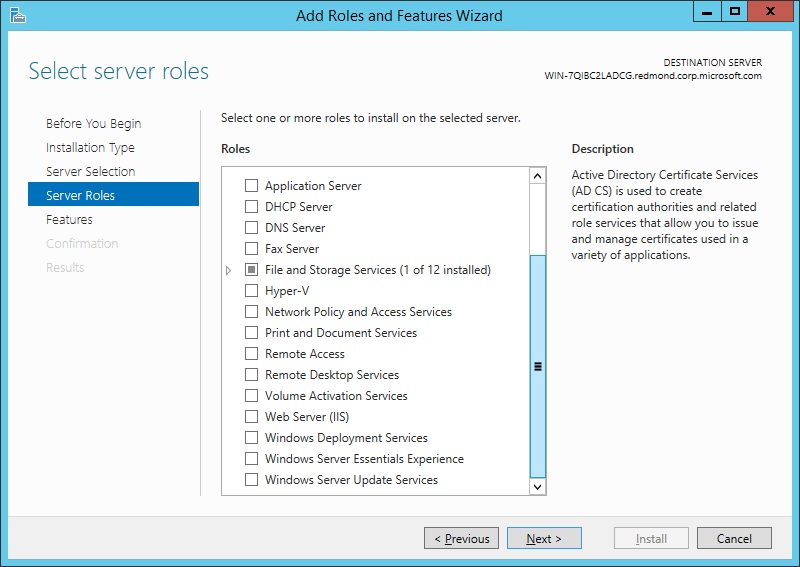
On the Server Roles page, select Spider web Server (IIS).
-
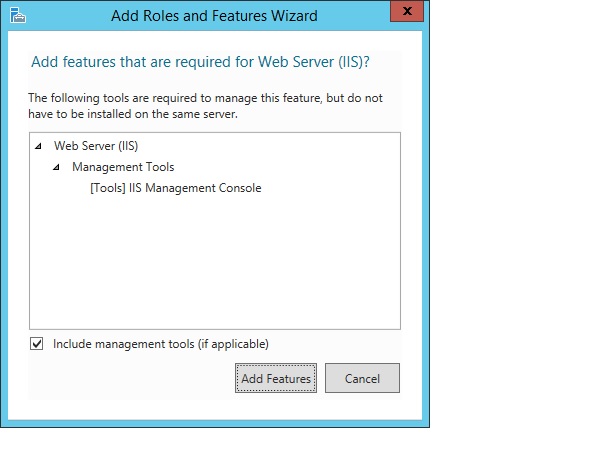
In the Add Roles and Features wizard, click Add Features if yous want to install the IIS Management Console. If yous do not want to install the Management Panel, uncheck Include management tools (if applicable), so click Go on.
-
On the Server Roles folio, click Next.
Note
The features required for the default role services of Management Tools and IIS Management Console will exist preselected in the Features page.
-
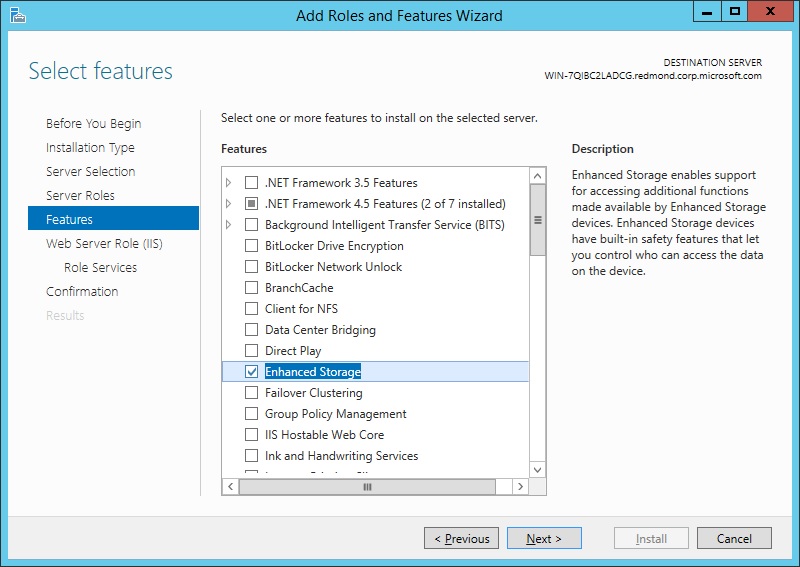
On the Features folio, select any features that y'all would similar to install, and so click Adjacent. Note that you do not need to select any features on this page to install IIS. IIS setup will select the features that are required.
-
On the Web Server Role (IIS) page, click Side by side.
-
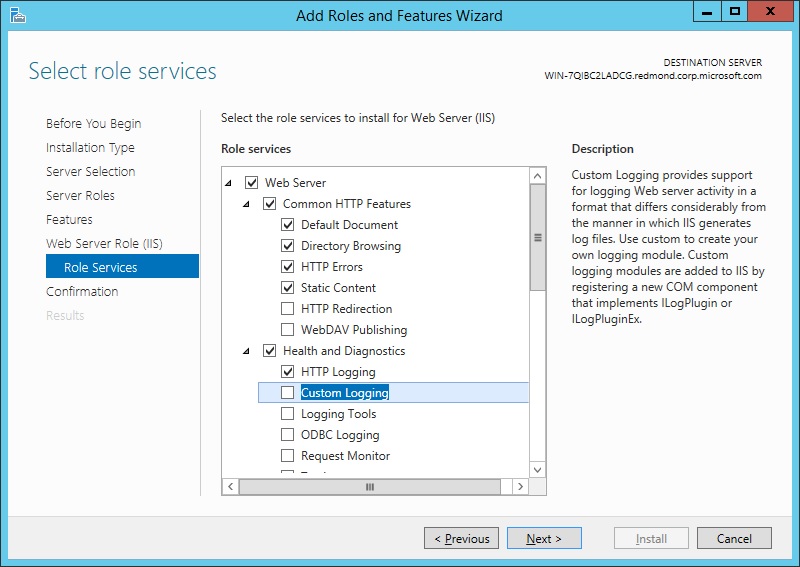
On the Role Services folio, select whatever boosted office services that you lot want to install.
Annotation
When you lot install IIS for the kickoff time past selecting Web Server (IIS), you lot will get at to the lowest degree the default installation that includes a minimum set of role services. Yous can see at this betoken that those default services are preselected on the Server Roles page. For a list of the server roles bachelor, and which roles are installed by default, see Modules in IIS eight.5. Yous volition take the chance to select more than role services afterward in this procedure.
Annotation
You tin too deselect office services that were selected by default when y'all selected Web Server. Notwithstanding, at to the lowest degree one office service must be selected for Web Server to exist selected and installed.
-
If you selected a function service that requires other part services or features to be installed, a page will exist opened indicating the role services or features to be installed. Leave Include management tools (if applicative) selected to select the install management tools associated with the server office. You may not demand the management tools on the destination server if you plan to manage the role remotely. Click Add Features to add the required role services or features.
-
Afterward you have added the role services that you need on the Role Services page, click Adjacent.
-
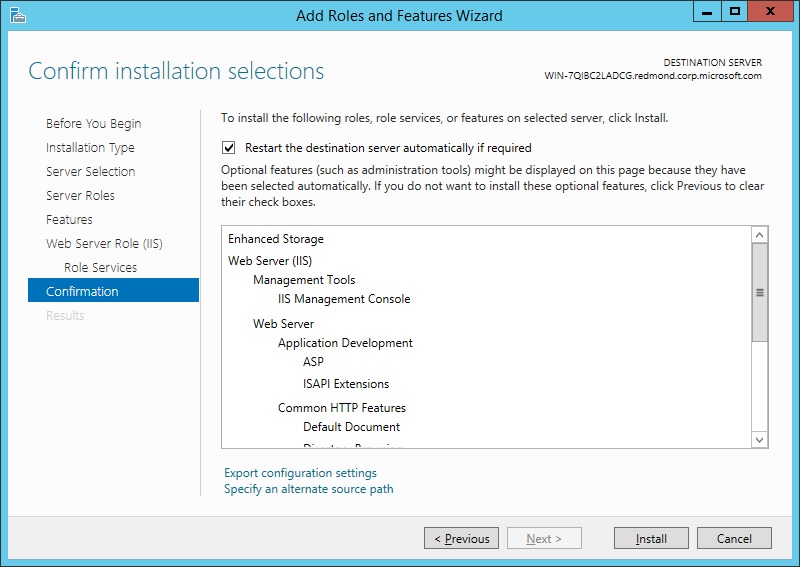
On the Confirmation page, verify the role services and features that are selected. Select Restart the destination server automatically if required to restart the destination server if the settings demand to take immediate effect. To save the configuration information to an XML-based file that you can employ for unattended installations with Windows PowerShell, select Export configuration settings, move to the advisable path in the Save Every bit dialog box, enter a file name, and and then click Save.
When you are ready to start the installation process on the Confirmation page, click Install.
-
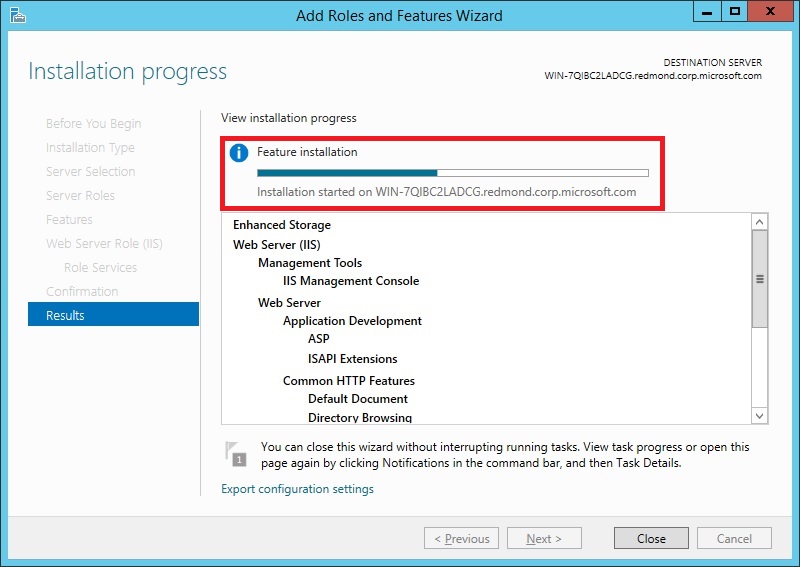
The Installation Progress page is displayed. You can close the wizard without interrupting running tasks. You can view chore progress or open the folio again past clicking Notifications in the notification expanse, and and then clicking Task Details.
-
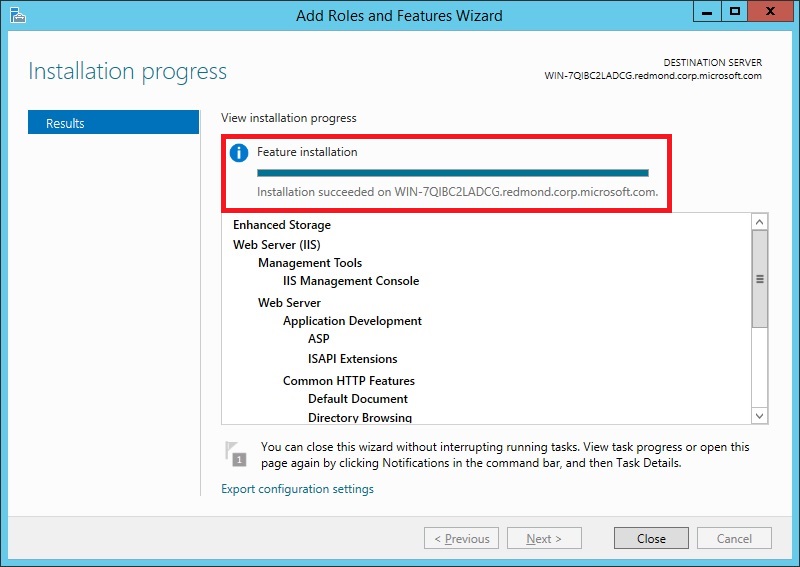
On the Results page, verify that the installation succeeds, and so click Close.
-
Confirm that the Spider web server works by opening a Web browser, and verifying that the post-obit default Web page is displayed when yous apply the
http://localhostaddress.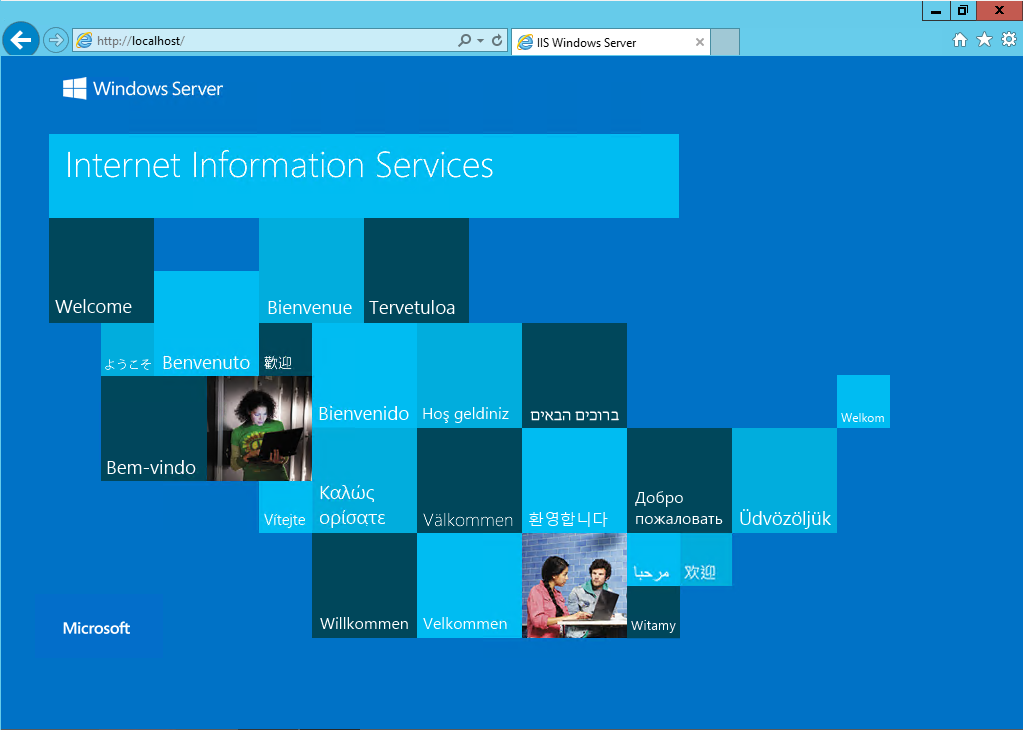
Install additional IIS viii.5 role services in the Server Managing director
Afterward you take installed the Web Server office on a running concrete server for the first time, you can run through the installation process again to install additional roles, role services, and features.
-
Open up Server Manager by clicking the Server Manager icon on the desktop.
-
In the Server Director window, with the Dashboard and Quick Start selected, click Add roles and features, or click the Manage carte du jour, and then click Add together Roles and Features. The Add Roles and Features wizard volition start with a Before You Brainstorm folio. The magician asks for verification of the following:
- The administrator account has a strong password.
- The network settings, such as IP addresses, are configured.
- The nearly electric current security updates from Windows® Update are installed.
-
On the Earlier You lot Begin page, click Adjacent.
-
On the Installation Type page, select Role-based or feature-based installation to configure a single server. Click Next.

-
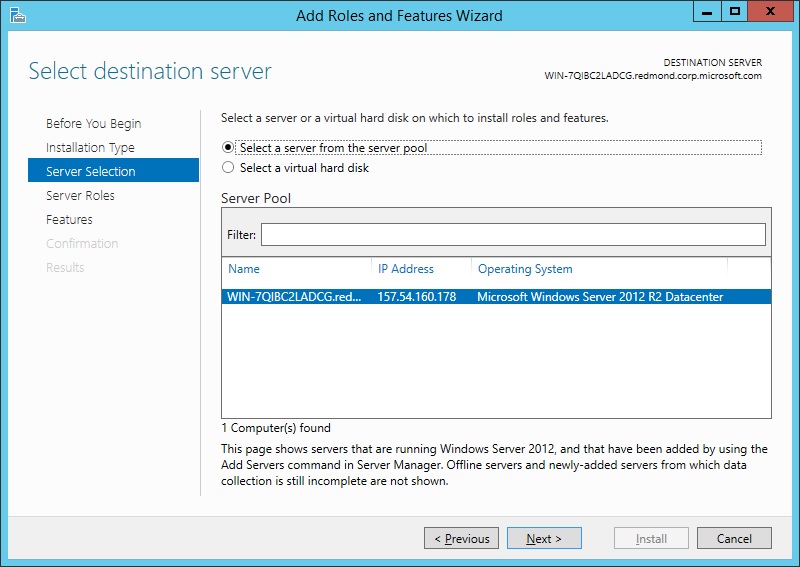
On the Server Option page, select Select a server from the server puddle, and so select a server; or select Select a virtual difficult disk server, select the server to mount the VHD on, and then select the VHD file. Click Side by side.
Note
To connect to the virtual hard disk drive, the virtual machine must be turned off and disconnected. If you select a VHD file from a network share, that share must grant Read and Write permissions to the computer (local system) business relationship of the server that you selected to mount the VHD (user-only business relationship access is not sufficient).
Note
Servers in a server pool volition exist available just if they have been added by the Add other servers to manage command in the Server Manager.
Note
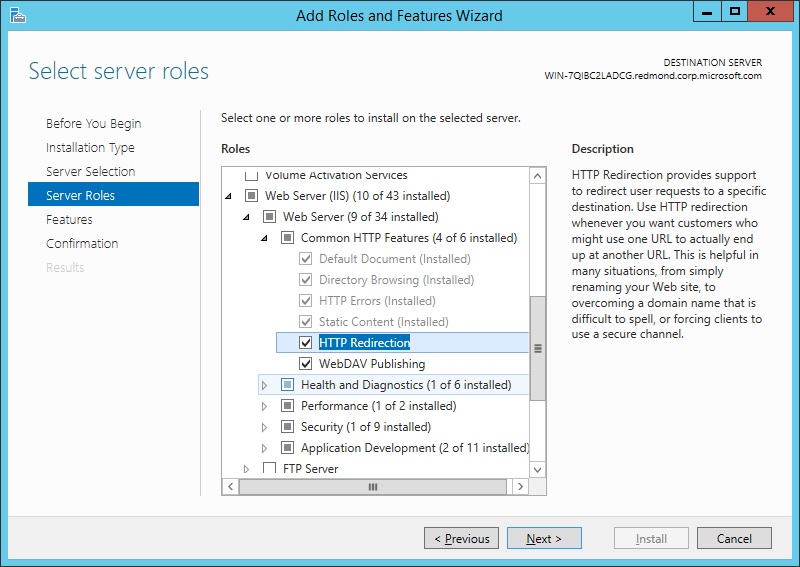
On the Server Roles page, Web Server (IIS) will be selected when IIS 8.0 has already been installed. If Web server (IIS) is not selected, perform the procedure in Install IIS viii.v for the first time in the Server Manager.
-
On the Server Roles folio, open the Web Server (IIS) tree until you encounter a function service that you want to install. Select the role service.
Note
Those roles, services, and features that have already been installed volition be identified by "Installed" in parentheses later on the proper noun, and the name will be grayed out. To remove a part, service, or characteristic, see Uninstall IIS viii.v Using the Server Director. Annotation, however, that you can expand the lower-level entries under a node even when the node is grayed out.
Note
For a list of the server roles that are available, and which roles are installed by default, see Modules in IIS viii.v beneath.
-
If the office service that y'all selected requires other role services or features to exist installed, an Add Features page will be opened listing those required office services or features. Exit Include direction tools (if applicable) selected to select the install management tools associated with the server role. Y'all may not need the management tools on the destination server if yous plan to manage the role remotely. Click Add Features to add the required role services or features to the installation.

-
If you need any additional role services, repeat steps 6 and seven.
Note
Add merely the modules that are necessary to minimize the IIS installation footprint and the attack surface.
When yous have selected all required role services, and their dependencies, on the Server Roles folio, click Adjacent.
-
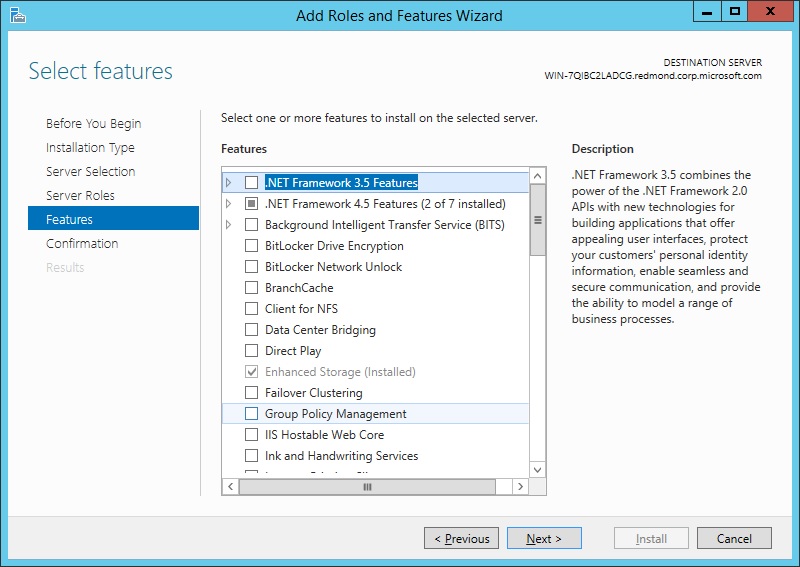
On the Features folio, select any features that you lot need to exist installed. Any features required to be installed for role services that yous selected in step 6 volition already be selected. Click Next.
-
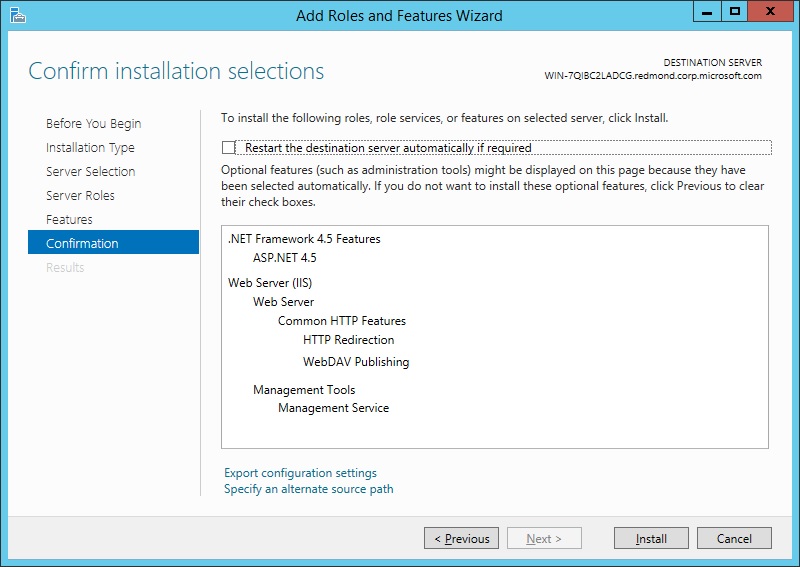
On the Confirmation page, verify the role services and features that are selected. Select Restart the destination server automatically if required to restart the destination server if the settings demand to accept immediate upshot. To relieve the configuration information to an XML-based file that you tin can use for unattended installations with Windows PowerShell, select Export configuration settings, motion to the appropriate path in the Save As dialog box, enter a file name, and then click Save.
When you are set up to start the installation process on the Confirmation folio, click Install.
-
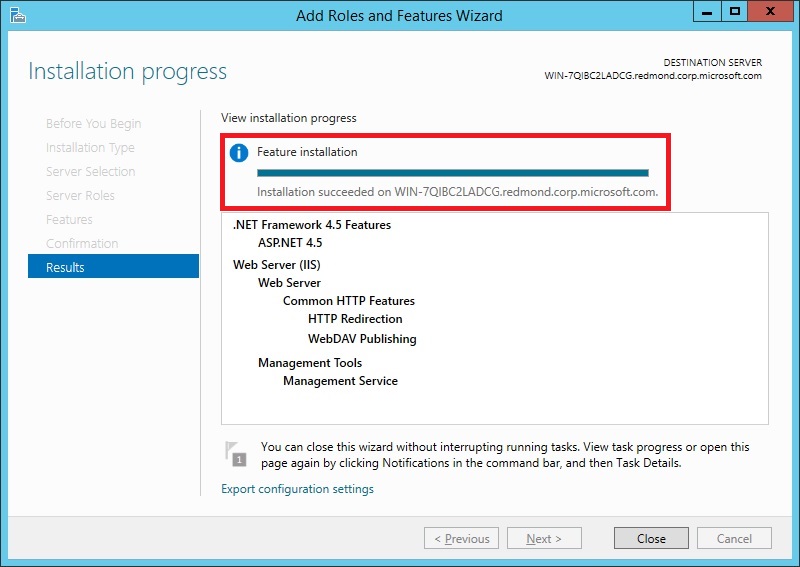
The Installation Progress page is displayed. You can close the wizard without interrupting running tasks. You can view job progress or open the page once more by clicking Notifications in the notification expanse, and then clicking Chore Details.

-
On the Results page, verify that the installation succeeds, and then click Close.
-
Confirm that the Web server works by opening a Web browser, and verifying that the post-obit default Web folio when you utilize the
http://localhostaddress.
Uninstall IIS 8.5 using the Server Manager
In the Add Roles and Features wizard of Server Manager, y'all cannot delete existing features that accept already been installed. To delete roles and features, use the Remove Roles and Features wizard of Server Managing director. You lot can remove an private role, role service, or feature by unchecking it in the wizard, or y'all tin uninstall all of IIS by unchecking the IIS Spider web Server Function.
-
Open Server Manager by clicking the Server Managing director icon on the desktop.
-
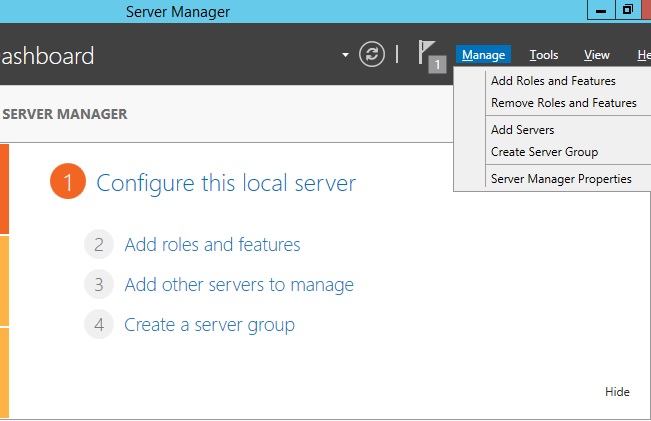
Click Manage at the superlative of the Server Manager, and then click Remove Roles and Features.
-
On the Before you begin page, click Side by side.
-
On the Server Selection folio, select the server from the server pool, and then click Next.

-
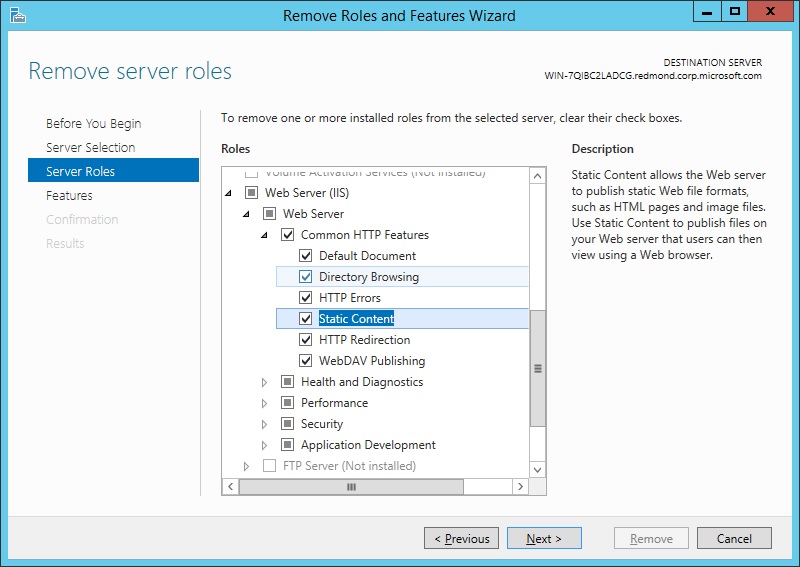
On the Remove Server Roles page, clear the cheque box of any server role or role service that you would like to remove.
-
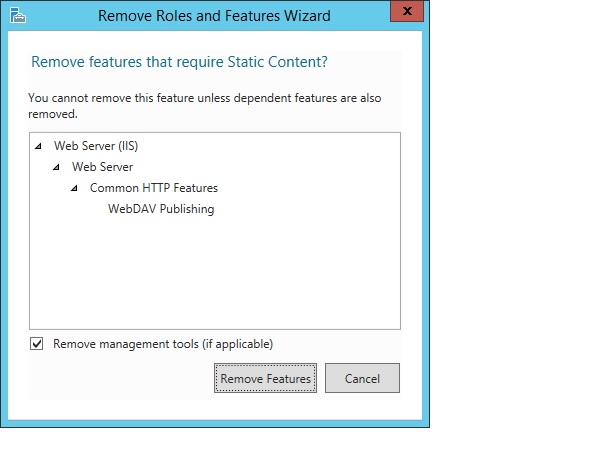
If you uncheck a role service that has characteristic dependencies, the Remove Features dialog box will exist displayed showing the dependencies. Click Remove Features to remove them. You can remove all of IIS by unchecking Web Server (IIS).
-
On the Remove Server Roles folio, select whatever other office or role service that you want to remove, and and then click Adjacent.
-
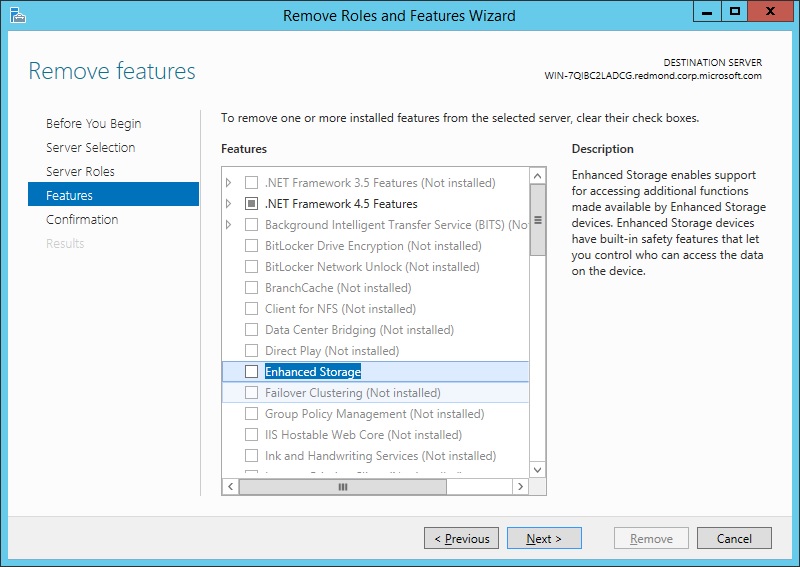
On the Features page, uncheck any characteristic that you would like to remove. If yous uncheck a characteristic that has feature dependencies, a dialog box will be displayed showing the dependencies. Click Remove Features to remove them. On the Features page, click Next.
-
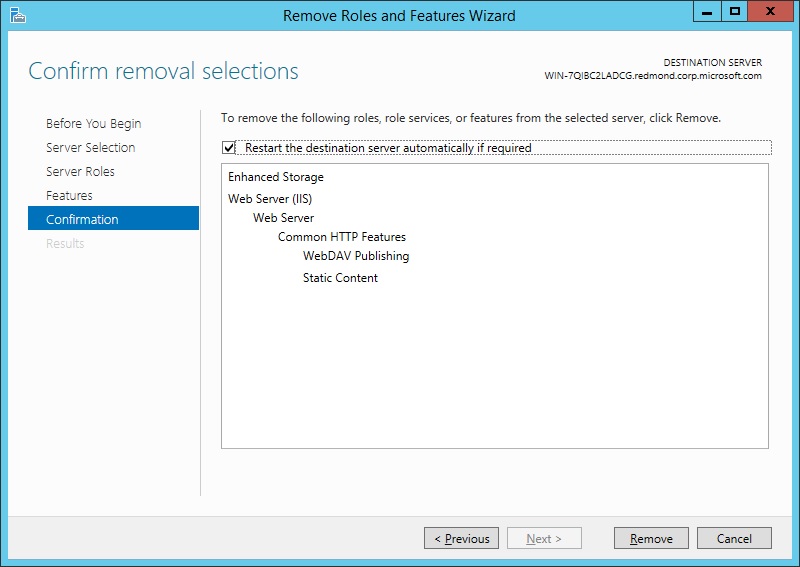
On the Confirmation page, verify that the roles, role services, and features to be removed are right, then click Remove.
Note
It is recommended that you do a restart if you are prompted to do so, unless yous have other activities that yous want to exercise earlier the restart takes place. A restart is especially important when you remove roles, part services, or features.
-
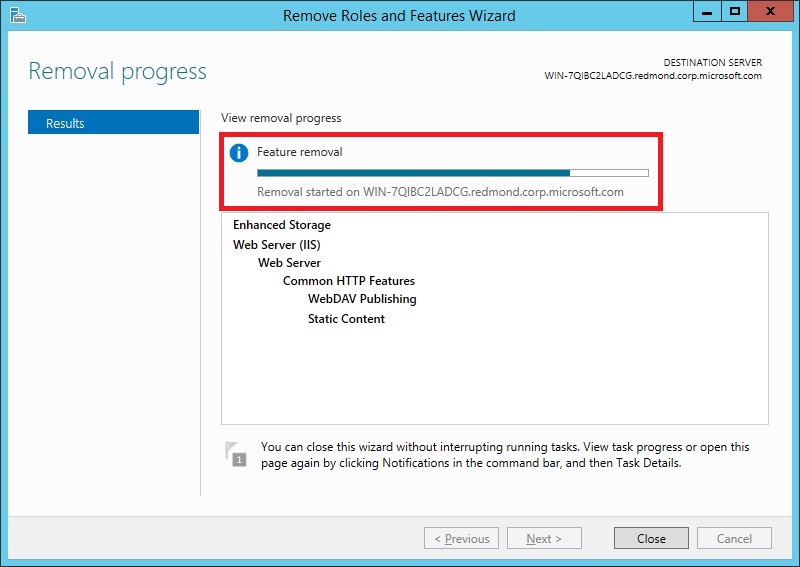
The Removal Progress page is displayed. You tin can close the wizard without interrupting running tasks. You can view job progress or open up the page again by clicking Notifications in the notification surface area, and and so clicking Task Details.
-
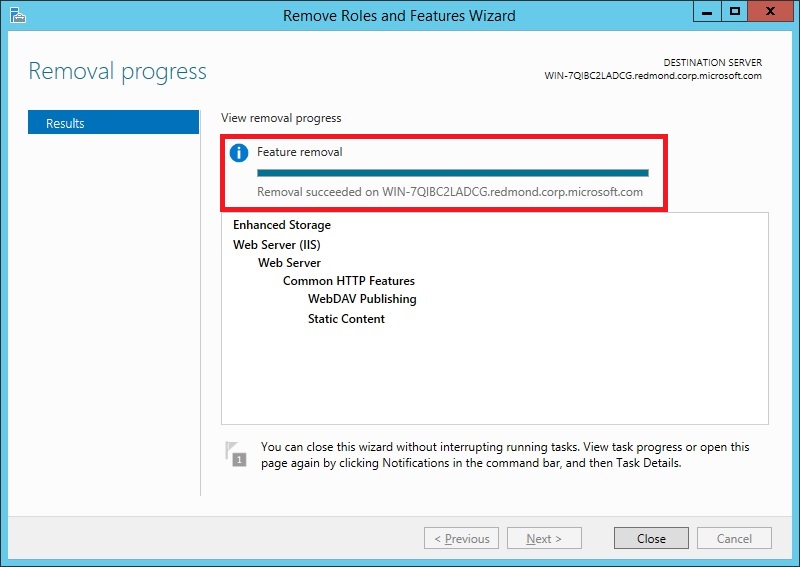
On the Results page, click Close.
-
Restart the destination server to finish removing features.
Install IIS 8.v from the Command Line
You can install IIS viii.5 from the command line using DISM or PowerShell. Note that DISM and PowerShell have different namespaces for installation parameters, so the parameter names used in their commands will be different. For more information, see Modules in IIS 8.5.
Note
Pkgmgr.exe has been deprecated. Utilize DISM instead for scripts installing IIS eight.5.
Install IIS 8.v using DISM
Automating the installation of IIS by using unattended scripts is very useful if you need to deploy multiple Web servers and want to ensure that each of the Web servers is ready upwardly with identical components and services. In Windows Server 2012 R2, DISM is used for unattended scripts, letting yous install or uninstall optional features from a command prompt or scripts. To use DISM, yous must make sure y'all accept administrative user rights on the computer. For more data about DISM, see DISM Overview
If you do non explicitly include in the DISM lawmaking a feature that the IIS installation has a dependency on, the installation volition fail, and will not generate an error message. For a list of dependencies required, see Characteristic Dependencies.
For a full list of the DISM parameters corresponding to IIS roles, services, and features, meet Modules in IIS eight.5.
The following script will install all roles, role services, and features of IIS 8.v, getting the full IIS installation that includes all bachelor feature packages. If there are roles, role services, or features that you do not need, you should edit the script to include only those that you crave. The social club of the commands in the DISM script does not thing. The unabridged script will be handed off to the engine and treated as i transaction. To install IIS eight.5 with a script, type the following on one line in an elevated command prompt.
DISM.EXE /enable-feature /online /featureName:IIS-WebServerRole /featureName:IIS-WebServer /featureName:IIS-CommonHttpFeatures /featureName:IIS-StaticContent /featureName:IIS-DefaultDocument /featureName:IIS-DirectoryBrowsing /featureName:IIS-HttpErrors /featureName:IIS-HttpRedirect /featureName:IIS-ApplicationDevelopment /featureName:IIS-ASPNET /featureName:IIS-NetFxExtensibility /featureName:IIS-ASPNET45 /featureName:IIS-NetFxExtensibility45 /featureName:IIS-ASP /featureName:IIS-CGI /featureName:IIS-ISAPIExtensions /featureName:IIS-ISAPIFilter /featureName:IIS-ServerSideIncludes /featureName:IIS-HealthAndDiagnostics /featureName:IIS-HttpLogging /featureName:IIS-LoggingLibraries /featureName:IIS-RequestMonitor /featureName:IIS-HttpTracing /featureName:IIS-CustomLogging /featureName:IIS-ODBCLogging /featureName:IIS-Security /featureName:IIS-BasicAuthentication /featureName:IIS-WindowsAuthentication /featureName:IIS-DigestAuthentication /featureName:IIS-ClientCertificateMappingAuthentication /featureName:IIS-IISCertificateMappingAuthentication /featureName:IIS-URLAuthorization /featureName:IIS-RequestFiltering /featureName:IIS-IPSecurity /featureName:IIS-Performance /featureName:IIS-HttpCompressionStatic /featureName:IIS-HttpCompressionDynamic /featureName:IIS-WebDAV /featureName:IIS-WebServerManagementTools /featureName:IIS-ManagementScriptingTools /featureName:IIS-ManagementService /featureName:IIS-IIS6ManagementCompatibility /featureName:IIS-Metabase /featureName:IIS-WMICompatibility /featureName:IIS-LegacyScripts /featureName:IIS-FTPServer /featureName:IIS-FTPSvc /featureName:IIS-FTPExtensibility /featureName:NetFx4Extended-ASPNET45 /featureName:IIS-ApplicationInit /featureName:IIS-WebSockets /featureName:IIS-CertProvider /featureName:IIS-ManagementConsole /featureName:IIS-LegacySnapIn Install IIS 8.v using PowerShell
You lot can employ the following PowerShell cmdlets to install all of IIS viii.5:
import-module servermanager add-windowsfeature web-server -includeallsubfeature To install only specific features, listing them in the PowerShell cmdlet, as in the post-obit case:
import-module servermanager add together-windowsfeature Web-Server, Web-WebServer, Spider web-Security, Spider web-Filtering The following points utilise to running the PowerShell cmdlets:
- The cmdlet requires top. You must exist running a Windows PowerShell session as an administrator to run the cmdlet.
- The cmdlet does non install management tools for roles, office services, and features past default. Y'all must add the IncludeManagementTools parameter to the cmdlet to do then.
For a full list of the PowerShell parameters corresponding to IIS viii.5 roles, services, and features, with more data, see Modules in IIS 8.5. The post-obit lists all these parameters.
- Spider web-Server
- Web-WebServer
- Web-Security
- Web-Filtering
- Web-Cert-Auth
- Web-IP-Security
- Spider web-Url-Auth
- Web-Windows-Auth
- Spider web-Basic-Auth
- Web-Client-Auth
- Web-Digest-Auth
- Web-CertProvider
- Spider web-Common-Http
- Web-Http-Errors
- Web-Dir-Browsing
- Spider web-Static-Content
- Web-Default-Doc
- Web-Http-Redirect
- Web-DAV-Publishing
- Web-Performance
- Spider web-Stat-Compression
- Web-Dyn-Pinch
- Web-Health
- Spider web-Http-Logging
- Spider web-ODBC-Logging
- Web-Log-Libraries
- Web-Custom-Logging
- Web-Request-Monitor
- Spider web-Http-Tracing
- Spider web-App-Dev
- Web-Internet-Ext
- Web-Net-Ext45
- Web-ASP
- Web-Asp-Net
- Spider web-Asp-Net45
- Web-CGI
- Web-ISAPI-Ext
- Spider web-ISAPI-Filter
- Web-WebSockets
- Web-AppInit
- Web-Includes
- Spider web-Ftp-Server
- Web-Ftp-Service
- Web-Ftp-Ext
- Spider web-Mgmt-Tools
- Web-Mgmt-Panel
- Web-Mgmt-Compat
- Web-Metabase
- Web-WMI
- Web-Lgcy-Mgmt-Console
- Web-Lgcy-Scripting
- Web-Scripting-Tools
- Web-Mgmt-Service
Uninstall IIS 8.5 using PowerShell
You lot can employ the PowerShell cmdlet UnInstall-WindowsFeature to uninstall IIS viii.5. Run get-help Install-WindowsFeature at a PowerShell command line to come across the syntax of the cmdlet. The following points apply to running the cmdlet:
- The cmdlet requires meridian. Yous must be running a Windows PowerShell session as an ambassador to run the cmdlet.
- The cmdlet does not uninstall management tools for roles, role services, and features by default. You must add the IncludeManagementTools parameter to the cmdlet to exercise then.
Modules in IIS 8.5
IIS modules are individual role services that the server uses to process requests. The following table shows which modules are available to exist installed in the Web server, which are installed by default, which role the office service is included in, the parameter used in DISM or PowerShell to install them, and a brief description of the functionality that they provide.
Annotation
An asterisk (*) in the table below denotes a function or role service that is installed by default when the Web Server (IIS) role is installed.
| Role | Role Service | DISM Parameter | PowerShell Parameter | Functionality |
|---|---|---|---|---|
| Web Server Function | IIS-WebServerRole | Web-Server | Provides support for HTML Web sites and optional support for ASP.Internet, ASP, and Web server extensions, enabling you to host an internal or external Web site or create Web-based applications. | |
| Web Server* | IIS-WebServer | Spider web-WebServer | Provides back up for HTML Web sites and optional back up for ASP.Net, ASP, and Web server extensions, enabling you to host an internal or external Web site or create Web-based applications. | |
| Common HTTP Features* | IIS-CommonHttpFeatures | Web-Common-Http | Supports basic HTTP functionality, such every bit delivering standard file formats and configuring custom server properties. | |
| Default Document* | IIS-DefaultDocument | Web-Default-Dr. | Enables y'all to configure a default file for the Spider web server to render when users practice non specify a file in a request URL. | |
| Directory Browsing* | IIS-DirectoryBrowsing | Web-Dir-Browsing | Enables users to come across the contents of a directory on a Web server when they do not specify a file in a request URL and default documents are either disabled or not configured. | |
| HTTP Errors* | IIS-HttpErrors | Web-Http-Errors | Enables y'all to customize the error messages that are returned to the users' browsers when the Spider web server detects a mistake condition, improving the user feel. | |
| Static Content* | IIS-StaticContent | Spider web-Static-Content | Enables the Spider web server to publish static Web file formats, such equally HTML pages and prototype files that can be viewed using a Web browser. | |
| HTTP Redirection | IIS-HttpRedirect | Web-Http-Redirect | Enables the Web server to redirect user requests that are sent to a specific destination. | |
| WebDAV Publishing | IIS-WebDAV | Web-DAV-Publishing | Web Distributed Authoring and Versioning. Enables you to publish files to and from a Web server past using the HTTP protocol, working through most firewalls without modification. | |
| Health and Diagnostics* | IIS-HealthAndDiagnostics | Web-Health | Provides an infrastructure to monitor, manage, and troubleshoot the health of Spider web servers, sites, and applications. | |
| HTTP Logging* | IIS-HttpLogging | Web-Http-Logging | Provides logging of Web site activity for the server, in addition to the logging provided by the operating organisation. | |
| Custom Logging | IIS-CustomLogging | Spider web-Custom-Logging | Enables yous to create a custom logging module that performs logging of Web server activity in a format that differs from the logging normally performed past IIS. | |
| Logging Tools | IIS-LoggingLibraries | Web-Log-Libraries | Provides an infrastructure to manage Web server logs and automate common logging tasks. | |
| ODBC Logging | IIS-ODBCLogging | Web-ODBC-Logging | Provides an infrastructure that supports logging Spider web server activity to an ODBC-compliant database, enabling you to programmatically display and manipulate logging information on an HTML page. | |
| Asking Monitor | IIS-RequestMonitor | Web-Request-Monitor | Provides an infrastructure to monitor Web application wellness by capturing information about HTTP requests. | |
| Tracing | IIS-HttpTracing | Web-Http-Tracing | Provides an infrastructure to diagnose and troubleshoot Spider web applications, including poor performance and hallmark-related failures. | |
| Performance* | IIS-Performance | Web-Functioning | Provides an infrastructure to enable more efficient utilise of bandwidth by performing compression of static and/or dynamic content. | |
| Static Content Compression* | IIS-HttpCompressionStatic | Web-Stat-Compression | Provides an infrastructure to configure HTTP compression of static content. | |
| Dynamic Content Compression | IIS-HttpCompressionDynamic | Web-Dyn-Compression | Provides an infrastructure to configure HTTP compression of dynamic content. | |
| Security* | IIS-Security | Spider web-Security | Provides an infrastructure for securing the Web server from users and requests, using one of multiple authentication methods. | |
| Request filtering* | IIS-RequestFiltering | Web-Filtering | Enables screening of all incoming requests to the server, and filters the requests based upon rules set by the administrator. | |
| Basic Authentication | IIS-BasicAuthentication | Web-Basic-Auth | An authentication method in which users are prompted to supply credentials that are transmitted unencrypted across the network. | |
| Centralized SSL Certificate | IIS-CertProvider | Web-CertProvider | An authentication method that uses SSL server certificates that are managed centrally using a file share. | |
| Customer Document Mapping Hallmark | IIS-ClientCertificateMappingAuthentication | Spider web-Client-Auth | An hallmark method that uses customer certificates to authenticate users, using Active Directory to offer one-to-one certificate mappings across multiple Web servers. | |
| Digest Authentication | IIS-DigestAuthentication | Web-Digest-Auth | An authentication method that sends a password hash to a Windows domain controller to authenticate users, peculiarly useful if users who must be authenticated volition access the Web site from backside firewalls and proxy servers. | |
| IIS Client Certificate Mapping Authentication | IIS-IISCertificateMappingAuthentication | Web-Cert-Auth | An authentication method that uses client certificates to authenticate users, using IIS to offer one-to-ane or many-to-one certificate mapping. | |
| IP and Domain Restrictions | IIS-IPSecurity | Web-IP-Security | An authentication method that enables you to enable or deny content based upon the originating IP accost or the domain proper name of the asking. | |
| URL Authorization | IIS-URLAuthorization | Web-Url-Auth | An authentication method that enables you to create URL authorization rules that restrict access to Spider web content. | |
| Windows Hallmark | IIS-WindowsAuthentication | Web-Windows-Auth | An authentication method that enables administrators in a Windows domain to take advantage of the domain infrastructure for authenticating users, a low-price authentication solution for internal Web sites. | |
| Application Development | IIS-ApplicationDevelopment | Web-App-Dev | Provides an infrastructure for developing and hosting Web applications, useful for creating Spider web content and extending the functionality of IIS. | |
| .Net Extensibility iii.five | IIS-NetFxExtensibility | Web-Net-Ext | Enables managed code developers to change, add, and extend Spider web server functionality in the entire request pipeline, the configuration, and the UI. | |
| .Internet Extensibility 4.5 | IIS-NetFxExtensibility45 | Spider web-Net-Ext45 | Enables managed code developers to change, add, and extend Web server functionality in the entire request pipeline, the configuration, and the UI. | |
| Application Initialization | IIS-ApplicationInit | Web-AppInit | Enables you to perform expensive Spider web application initialization tasks before serving Web pages. | |
| ASP | IIS-ASP | Spider web-ASP | Provides a server-side scripting environs for building Web sites and Web applications, especially for existing applications. | |
| ASP.Cyberspace 3.five | IIS-ASPNET | Web-Asp-Internet | Provides a server-side object-oriented programming environment for edifice Web sites and Spider web applications using managed code. | |
| ASP.Cyberspace 4.5 | IIS-ASPNET45 | Web-Asp-Net45 | Provides a server-side object-oriented programming environment for building Web sites and Web applications using managed code. | |
| CGI | IIS-CGI | Web-CGI | Defines how a Web server passes information to an external program. | |
| ISAPI Extensions | IIS-ISAPIExtensions | Web-ISAPI-Ext | Internet Server Programming Interface Extensions. Provides back up for dynamic Web content evolution. | |
| ISAPI Filters | IIS-ISAPIFilter | Web-ISAPI-Filter | Internet Server Programming Interface Filters. Enables you lot to extend or modify the functionality provided by IIS, reviewing every request made to the Web server and processing the appropriate requests. | |
| Server Side Includes | IIS-ServerSideIncludes | Web-Includes | A scripting language used to dynamically generate HTML pages, using script that is run on the server before the page is delivered to the client. | |
| WebSocket Protocol | IIS-WebSockets | Spider web-WebSockets | Provides communication channels for server applications created with IIS 8.x and ASP.NET 4.five. | |
| FTP Server | IIS-FTPServer | Web-Ftp-Server | Enables the transfer of files between a client and a server, using either an FTP client or an FTP-enabled Web browser. | |
| FTP Service | IIS-FTPSvc | Spider web-Ftp-Service | Enables FTP publishing on a Web server. | |
| FTP Extensibility | IIS-FTPExtensibility | Spider web-Ftp-Ext | Enables support for FTP extensibility features such as customer providers, ASP.Internet users, or IIS Director users. | |
| IIS Hostable Web Core (IIS 8.0, not IIS 8.5) | IIS-HostableWebCore | Web-WHC | Enables you to write custom code that volition host core IIS functionality in your own awarding that serves HTTP requests and uses its own applicationHost.config and root Web.config configuration files. | |
| Direction Tools* | IIS-WebServerManagementTools | Web-Mgmt-Tools | Provides an infrastructure for managing a Spider web server that runs IIS seven.0 or later. | |
| IIS Management Console* | IIS-ManagementConsole | Spider web-Mgmt-Panel | Provides an infrastructure for managing an IIS seven.0 or later Web server, local or remote, using a user interface. | |
| IIS vi Management Compatibility | IIS-IIS6ManagementCompatibility | Web-Mgmt-Compat | Provides forward compatibility for applications and scripts that use the IIS 6 APIs, Admin Base Object (ABO) and Active Directory Service Interface (ADSI). | |
| IIS 6 Metabase Compatibility | IIS-Metabase | Spider web-Metabase | Provides an infrastructure for querying and configuring the Metabase, so that you can run applications and scripts migrated from earlier versions of IIS that use Admin Base Object (ABO), and Active Directory Service Interface (ADSI). | |
| IIS 6 Management Console | IIS-LegacySnapIn | Web-Lgcy-Mgmt-Panel | Provides an infrastructure for administration of remote IIS 6.0 servers. | |
| IIS 6 Scripting Tools | IIS-LegacyScripts | Web-Lgcy-Scripting | Enable yous to continue to use scripts built to manage IIS vi in IIS seven.0 or afterwards, especially if your applications and scripts apply ActiveX Information Objects (ADO) or Active Directory Service Interface (ADSI). | |
| IIS 6 WMI Compatibility | IIS-WMICompatibility | Spider web-WMI | Provides Windows Management Instrumentation (WMI) scripting interfaces to programmatically manage and automate tasks for an IIS viii.0 or later Web server. | |
| IIS Management Scripts and Tools | IIS-ManagementScriptingTools | Spider web-Scripting-Tools | Provides an infrastructure to programmatically manage an IIS 7.0 or later Spider web server by using commands in a command window or past running scripts. | |
| Management Service | IIS-ManagementService | Web-Mgmt-Service | Enables the Web server to be managed remotely from another computer using IIS Manager. |
Feature Dependencies
The post-obit table shows which role services and features must be installed for the part service or features in the tabular array row to exist installed.
The Add Roles and Features Wizard and Remove Roles and Features Wizard of Server Manager take care of dependencies by prompting you to add together dependencies when adding a role service or feature, or to remove dependencies when removing a office service or feature. Notwithstanding, when y'all install IIS using DISM, you need to include in the DISM lawmaking any dependency that a role service or characteristic being installed has, or the installation volition neglect, and you lot may not receive an indication why it failed.
When you remove a role service or feature, brand sure that you do non remove a service or feature that another service or feature has a dependency on. In that location tin be an intersection of dependencies, for case between ASP and ASP.NET. And so if you were to remove ASP, and remove its characteristic dependencies, you could remove dependencies for ASP.NET, besides.
| Part | Role Service | Dependency |
|---|---|---|
| Spider web Server Part | None | |
| Spider web Server* | None | |
| Mutual HTTP Features* | None | |
| Default Document* | None | |
| Directory Browsing* | None | |
| HTTP Errors* | None | |
| Static Content* | None | |
| HTTP Redirection | None | |
| WebDAV Publishing | Static Content | |
| Health and Diagnostics* | None | |
| HTTP Logging* | None | |
| Custom Logging | None | |
| Logging Tools | None | |
| ODBC Logging | None | |
| Asking Monitor | None | |
| Tracing | None | |
| Performance* | None | |
| Static Content Compression* | None | |
| Dynamic Content Compression | None | |
| Security* | None | |
| Request filtering* | None | |
| Basic Authentication | None | |
| Centralized SSL Certificate | None | |
| Customer Document Mapping Authentication | None | |
| Digest Authentication | None | |
| IIS Client Certificate Mapping Authentication | None | |
| IP and Domain Restrictions | None | |
| URL Authorization | None | |
| Windows Authentication | None | |
| Application Development | None | |
| .NET Extensibility three.five | - .NET Framework 3.5 (includes .NET 2.0 and 3.0) - ASP.NET 4.5 - .Net Framework 4.v - Awarding Evolution - Asking Filtering | |
| .Internet Extensibility 4.5 | - ASP.Net 4.5 - .Net Framework 4.5 - Application Evolution - Request Filtering | |
| Awarding Initialization | None | |
| ASP | - Web Server (IIS)-Web Server- Application Development- ISAPI Extensions - Request Filtering | |
| ASP.Internet three.5 | - .Cyberspace Framework iii.5 (includes .NET 2.0 and 3.0) - ASP.NET 4.5 - .NET Framework 4.v - ISAPI Extensions - ISAPI Filters - .NET Extensibility three.5 - Request Filtering | |
| ASP.NET 4.five | - ASP.NET 4.5 - .NET Framework four.v - ISAPI Extensions - ISAPI Filters - .NET Extensibility 3.5 - Asking Filtering | |
| CGI | None | |
| ISAPI Extensions | None | |
| ISAPI Filters | None | |
| Server Side Includes | None | |
| WebSocket Protocol | None | |
| FTP Server | None | |
| FTP Service | None | |
| FTP Extensibility | FP Service | |
| IIS Hostable Spider web Core (IIS 8.0, not IIS 8.5) | None | |
| Direction Tools* | - .NET Framework 4.v - Graphic Management Tools and Infrastructure - Windows PowerShell 3.0 | |
| IIS Management Console* | - .NET Framework 4.5 - Graphic Management Tools and Infrastructure - Management Tools - Windows PowerShell three.0 | |
| IIS six Management Compatibility | None | |
| IIS 6 Metabase Compatibility | None | |
| IIS 6 Management Console | - .NET Framework 4.v - Graphic Management Tools and Infrastructure - IIS 6 Metabase Compability - Windows PowerShell iii.0 | |
| IIS vi Scripting Tools | - IIS 6 Metabase Compatibility - IIS vi WM Compatibility | |
| IIS vi WMI Compatibility | IIS half-dozen Metabase Compatibility | |
| IIS Management Scripts and Tools | None | |
| Management Service | - ASP.NET 4.5 - .NET Framework 4.five - Management Tools |
Meet also
- Install or Uninstall Roles, Part Services, or Features
- IIS.NET Install
- What's New in IIS 8.5
- DISM Overview
- Editing Configuration Files
- Extending IIS Configuration
Source: https://docs.microsoft.com/en-us/iis/install/installing-iis-85/installing-iis-85-on-windows-server-2012-r2
Posted by: mcbridefarretionly.blogspot.com
0 Response to "How To Uninstall Iis In Windows Server 2012 R2"
Post a Comment