

How To Enter Windows Registry
How practice I open up and edit the Windows registry?
Updated: 12/05/2021 past Reckoner Hope
Fixing Windows errors, tweaking Windows features, or completely removing a program can sometimes crave y'all to edit the Windows registry. This folio provides aid with opening and viewing the Windows registry, editing, and deleting registry values.
How to open up the Windows registry
To open the Windows registry, follow the steps below for your version of Windows.
Note
If you have restricted access to the Windows estimator you're logged in to, you may not be able to access the Windows registry.
Windows 11
- On the Windows taskbar, click the magnifying glass icon.

- In the text field at the top of the search window, type regedit and press Enter.
- If prompted past User Account Control, click Yes to open the Registry Editor.
- The Windows Registry Editor window should open up and look similar to the example shown below.

Windows 10
- Type regedit in the Windows search box on the taskbar and press Enter.
- If prompted by User Business relationship Command, click Yes to open the Registry Editor.
- The Windows Registry Editor window should open up and look like to the example shown below.

Windows eight
- Type regedit on the Start screen and select the regedit pick in the search results.
- If prompted past User Account Control, click Aye to open the Registry Editor.
- The Windows Registry Editor window should open and look similar to the example shown below.
Windows 7 and earlier
- Click Start or printing the Windows cardinal.
- In the Offset menu, either in the Run box or the Search box, type regedit and press Enter. In Windows eight, y'all can type regedit on the Start screen and select the regedit pick in the search results. In Windows 10, type regedit in the Search box on the taskbar and press Enter.
- If prompted by User Account Command, click Aye to open up the Registry Editor.
- The Windows Registry Editor window should open and look similar to the example shown below.

How to scan the Windows registry
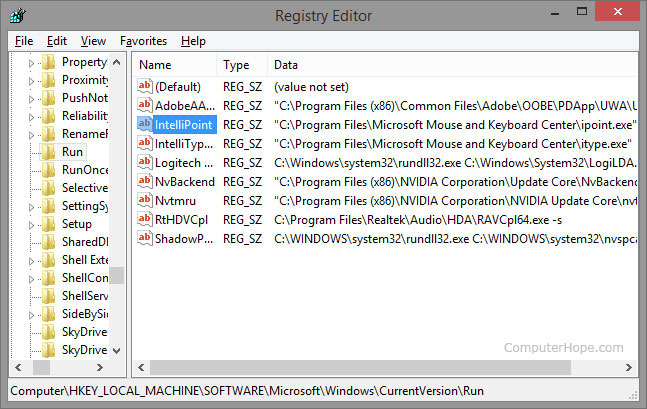
When nigh users edit their registry, they're given the location or path of where the registry value is located and what to change. Below is an example path for a commonly accessed registry subkey. To scan this location, yous commencement start past opening the HKEY_LOCAL_MACHINE primal (folder). In this key, you see the SOFTWARE folder, then Microsoft, Windows, CurrentVersion, and finally the Run binder.
HKEY_LOCAL_MACHINE\SOFTWARE\Microsoft\Windows\CurrentVersion\Run
Tip
Each backslash ("\") in a registry path represents another folder in the registry, with the name of that binder following the backslash.
Later navigating to the registry path above, you see a window similar to the instance below. In this example, you tin see four different cord value keys, which point to the programs that run each fourth dimension the estimator is turned on or restarted.
How to edit a Windows registry value
To edit a registry value, double-click the proper name of the value you want to edit. For instance, if we double-click the 'IntelliPoint' value in the example to a higher place, a new window appears that would allow us to modify the information value. In this case, nosotros could change the file path of where the "ipoint.exe" file is located for the IntelliPoint driver.
How to delete a Windows registry value
To delete a registry value, highlight whatsoever registry Name and press the Del key on the keyboard. For example, if we did not desire the IntelliPoint program to load each time Windows starts, we could highlight IntelliPoint and press Del.
Windows registry shorthand and abbreviations
In some documentation and online forums, the registry values may be abbreviated. For example, instead of proverb "HKEY_LOCAL_MACHINE," it is easier to say and write "HKLM." For a list of registry terms and shorthand, see our registry definition.
Source: https://www.computerhope.com/issues/ch001348.htm
Posted by: mcbridefarretionly.blogspot.com
0 Response to "How To Enter Windows Registry"
Post a Comment